
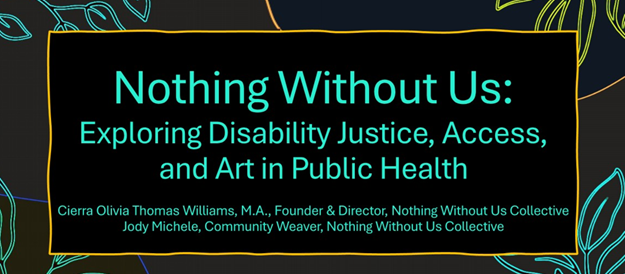
In September we hosted the three-part webinar series Nothing Without Us: Exploring Disability Justice, Access, and Art in Public Health, led by our colleagues at the Nothing Without Us Collective. We are sharing these recordings to increase access to this learning opportunity.
This three-part webinar series invites preventionists, advocates, and public health professionals to reimagine violence prevention through the lens of Disability Justice. Each session builds on the last, guiding participants from critical reflection to practical application. Together, these sessions create space for learning, reflection, and action. Participants will leave with concrete strategies, creative tools, and renewed commitment to prevention practices that honor Disabled survivors and advance public health practices to ensure thriving for all.
Learn more about the Nothing Without Us Collective here, and on Instagram at @nothing_without_us_collective
Session 1: Disability Justice and the Public Health Approach to Violence Prevention
This session introduces Disability Justice as a framework that challenges the limitations of traditional public health models. Participants will explore how ableism operates in prevention and begin reimagining strategies grounded in interdependence, collective access, and leadership of the most impacted.
Supplemental Resource: Planning for Change: Mapping Strategies, Outcomes, and Impact Across the SEM
Session 2: Complicating Accessibility in the Anti-violence Movement
This session deepens the conversation by examining how accessibility is often reduced to compliance. Participants will learn about the ADA from an expert and understand its strengths and limitations. Through a power analysis and critical engagement with legal frameworks, participants will learn to move beyond “check-the-box” inclusion toward transformative practices that redistribute resources and shift organizational culture.
Session 3: Art as a Catalyst: Centering Disability Justice in Primary Prevention
This session highlights art as both practice and pathway for prevention. Participants will engage with ideas that demonstrate how art can disrupt ableism, amplify marginalized voices, and serve as an accessible tool for evaluation and collective meaning-making.